


Ronald E. McNair, Ph.D.
(1950 – 1986)
“I believe that in our urban and rural cities there are great minds
and talents with hands that can control a spacecraft with the same
dexterity that they control and handle a basketball. These talents
must not be wasted.”
--Ronald E. McNair, spoken before the Massachusetts State Legislature
“Whether or not you reach your goals in life depends entirely on
how well you prepare for them and how badly you want them.”
--Ronald E. McNair
“True courage comes in enduring…persevering, the preparation
and believing in oneself.”
--Ronald E. McNair
Ronald Erwin McNair was born in the small town of Lake City, South Carolina in 1950. As a child, he lived in a house with no electricity or running water, attended segregated schools, and earned money by picking tobacco. In the face of these challenges, McNair’s consistent effort and unfailing tenacity allowed him to overcome his humble beginnings and become the second African American, after Guion Bluford, to fly in space.
Ever since the Soviet Union launched Sputnik in 1957, McNair was enthralled with space. This childhood interest turned into an adult fascination. After graduating as the valedictorian of his high school class, he took a scholarship to attend North Carolina Agricultural and Technical State University where he majored in physics. There, he became a member of the Omega Psi Phi fraternity (other notable members of this national fraternity include Langston Hughes, Hank Aaron, Bill Cosby, Jesse Jackson, and Michael Jordan among many others), was named a Presidential Scholar, and graduated magna cum laude in 1971.
After college, McNair immediately began a doctoral program in physics at the Massachusetts Institute of Technology (MIT), and became a Ford Foundation Fellow, a National Fellowship Fund Fellow, a NATO Fellow, and the Omega Psi Phi Scholar of the Year. Of his choice to attend MIT, McNair stated in an interview for Ebony magazine, “I couldn’t run away from a challenge. I had to compete with the best.” At MIT, he became one of the first people to begin developing chemical HF/DF and high-pressure CO lasers. His time at MIT was not without hardship, however. As McNair was nearing the end of his program, he lost all of his data, two years worth of laser physics research. Never one to let circumstances defeat him, McNair began his research again and produced a second set of data, which was said to be better than the first set, in less than a year. He was awarded his Ph.D. in Physics from MIT in 1976.
In 1977, McNair applied to the U.S. National Aeronautics and Space Administration’s (NASA) Space Shuttle program. Out of over 10,000 applicants, McNair was one of 35 candidates selected to become a member of the program. He became a mission specialist on Space Shuttle flight crews, and had his first mission on February 3, 1984.
During this time, McNair was awarded honorary doctorates from North Carolina A&T State University (1978), Morris College (1980), and the University of South Carolina (1984). He later received the Los Angeles Public School System’s Service Commendation (1979), the National Society of Black Professional Engineers Distinguished National Scientist Award (1979), and the Friend of Freedom Award (1981).
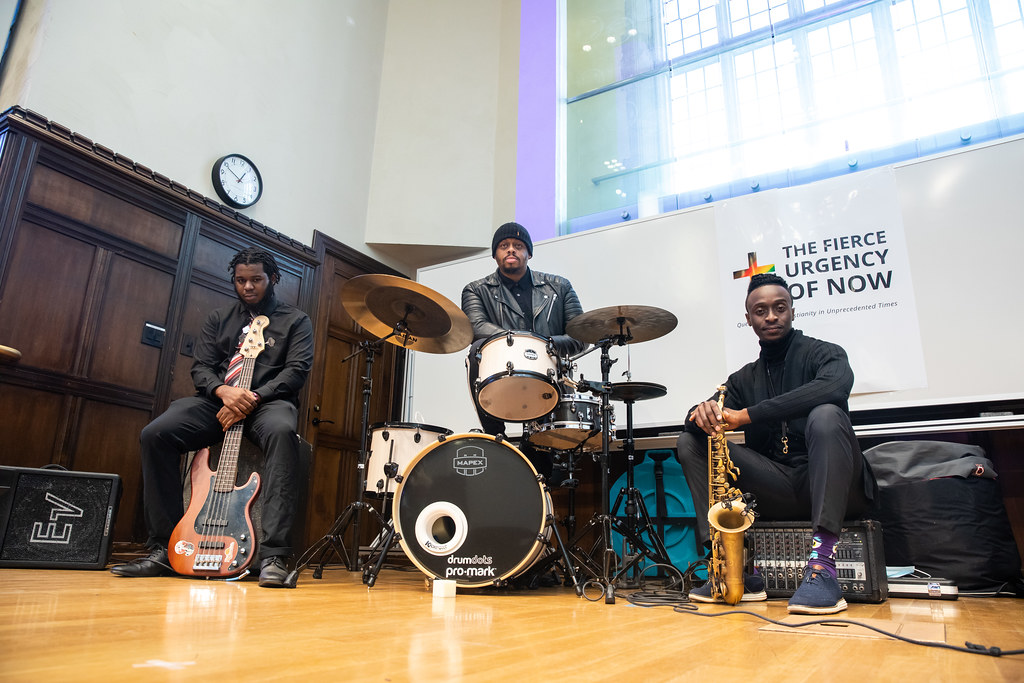
McNair was no average astronaut-physicist. He was also a fifth-degree black belt in karate; he won five regional Black Belt Karate Championships and, in the same year as he received his doctorate, he won the AAU Karate Gold Medal. He was also an accomplished jazz saxophonist, and planned to record the first-ever jazz saxophone recording in space.
Unfortunately, Dr. McNair never got to make this recording for he died tragically in the explosion of the Space Shuttle Challenger, moments after liftoff from the Kennedy Space Center on January 28, 1986. He perished along with six of his fellow astronauts and crewmates. He was survived by his wife and two children.
Posthumously, Ronald McNair was awarded the Congressional Space Medal of Honor, and Congress designated the federal TRIO program previously known as the Postbaccalaureate Achievement Program the Ronald E. McNair Postbaccalaureate Achievement Program in Dr. McNair's honor and memory.