



Bicycle Policy
Preamble
The University recognizes that concerns exist within the University
community regarding the safe use of bicycles on and about the campus.
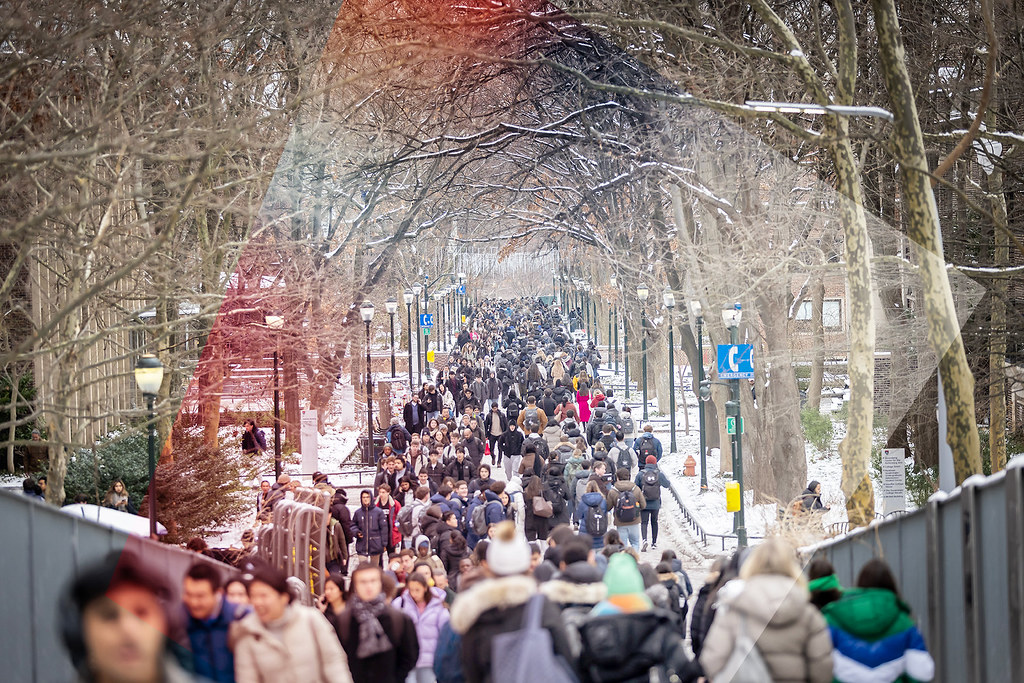
Pedestrians are concerned that they must be overly vigilant to avoid
physical encounters with cyclists, particularly in heavy traffic areas.
They argue that, to prevent a possible injury, walking a short distance
should not be a hardship on the cyclist. Many University community
members have concerns about bicycles impeding the free ingress/egress
of buildings, especially in the event of an emergency. Additionally
some experience extreme difficulty using the stairs when the handrails
are not accessible. Many are concerned about the disorderly appearance
of campus when bicycles are secured to trees, trip rails and other
inappropriate fixed objects.
Cyclists have legitimate concerns of their own. Their concerns
are that regulatory reaction by the University might impair their
functional use of bicycles for transportation to and about campus,
that there are an insufficient number of reliable bicycle racks
available, and that they are victimized by the theft of their bicycles
or component parts.
In order to address the concerns of the entire community, the
University has adopted the following bicycle use policy which, we
believe, balances and provides for the needs of all concerned parties.
Enforcement of the policy is authorized by the Pennsylvania Vehicle
Code, the Philadelphia Code and the Philadelphia Fire Code. However,
like most policies, it relies on the thoughtfulness, cooperation
and consideration of the entire University community.
Policy
- I. Purpose
- A. To enhance pedestrian and rider safety within the inner
campus during peak traffic periods.
- B. To provide for the safe and free ingress/egress to and from
all the University buildings and facilities.
- C. To reduce bicycle theft losses.
- D. To identify, establish and publish written guidelines and
regulations to facilitate the movement of bicycle traffic to and
about the campus while safeguarding the needs of the community
population, at large.
-
- II. Scope
This policy applies to all University faculty, staff and students
who own, operate or store any pedal drive, human powered vehicles,
on or about the building, grounds or premises of the University
of Pennsylvania, West Philadelphia campus.
-
- III. Policy defined
-
A. Registration
The University recommends that every bicycle owned, operated or
stored on or about the campus, should be registered with the University
Division of Public Safety. The advantages of bicycle registration
are:
- Police will have a quick means to establish the ownership
of a bicycle that has been removed from your control. Return
of the property, and if appropriate, the arrest of a thief
or receiver of stolen property will be greatly enhanced.
- If your bicycle is lost or stolen the University Police
(UPPD) will verify the existence of that bicycle to your insurance
carrier, if requested. If the bicycle is not registered UPPD
will take your report of lost or stolen property; however,
no verification of the prior existence of that bicycle, as
your property, can be affixed to that report when forwarded
to your insurance carrier.
- Bicycles remaining in UPPD custody without identification
of ownership are periodically sold at public auction. Dates,
times, and places of registration for bicycles will be widely
advertised throughout each academic year with periodic reminders
as may be appropriate with changes in the University population
such as the beginning of the spring semester and the summer
sessions.
-
B. Synopsis of Pennsylvania and Philadelphia law
- Human powered, pedal cycles are vehicles according to the
Pennsylvania Vehicle Code.
- Vehicles, as indicated in #1 above are subject to the provisions
of the vehicle code when operated on the highways and may
not stop, stand or park where prohibited or where controlled
by official traffic control devices to include firelanes,
handicapped zones, etc.
- The Philadelphia Code prohibits any person above the age
of 12 from riding a cycle on any sidewalk or pedestrian pathway
in a business district. The Penn Campus area meets the definition
of a business district.
- A person walking a bicycle is considered a pedestrian.
- The Philadelphia Fire Code requires clear passage from
all exits and stairways at all times. No obstruction shall
be permitted.
- University Police are authorized to enforce both the Pennsylvania
Vehicle Code and City of Philadelphia Ordinances.
-
C. Riding restricted by time or place
In order to provide the opportunity for the accident-free passage
of both pedestrians and cyclists the following riding restrictions
are instituted:
- Cyclists can ride their vehicles on Locust, Smith, and
Hamilton Walks only between the hours of 5:30 p.m. and 8:30
a.m. If heavy pedestrian traffic occurs it is expected that
riders will dismount in deference to pedestrians.
- Cyclists will walk their vehicles on Locust, Smith, and
Hamilton Walks between the hours of 8:30 a.m. and 5:30 p.m.
- The ride/walk provisions of 1 and 2 above, also apply to
the pedestrian feeders to Locust Walk from Walnut and Spruce
streets via 36th and 37th streets.
- University Police on bicycles will be exempt from the above
described restrictions in order to provide enforcement, efficient
patrol service and emergency response. Police, consistent
with their specialized training and the guidance of their
supervisors, will operate bicycles in a responsible manner.
-
D. Parking and Securing of Bicycles
In order to reduce the opportunity for theft the University has
significantly increased the number of structurally sound bicycle
security racks distributed at convenient locations throughout
inner campus. University Police are particularly attentive to
these concentrations of security racks during their patrols.
- Bicycles should be secured to a bike rack every time they
must be left unattended on campus, even if it is to be left
for a moment.
- Bicycles shall not be locked, secured, or otherwise parked
to handrails, fences, trees, trip rails, or to, or in any
other location that, in any manner, obscures the free ingress/egress
of any building, stairway, pathway, or in such a manner as
to interfere with the access to facilities as required by
the U.S. Americans with Disabilities Act.
- Locking Devices and Methods.
- a. The U-shaped Kryptonite-type bicycle locks appear
to be among the best types of locking devices.
- b. When physically possible secure the main frame to
the security rack.
- c. If wheels are of the quick-release type, attempt
to secure lock through the security rack, the bike frame
and the wheel. If necessary, use an additional lock with
a long shackle or a cable and lock to secure all the parts
together.
- d. If the bicycle is equipped with a quick-release seat
adjustment, consider removing the seat and taking it with
you.
- e. Never secure a bicycle to an object which can, itself,
be disassembled, cut or removed.
- f. Use the bicycle security racks on the inner campus.
-
E. Enforcement
In order to preserve the intent and the integrity of any policy
there must always be a means to ensure compliance. The University's
Division of Public Safety, Police department is charged with enforcement
action.
- Parking and securing of Bicycles. Owners or operators of bicycles
parked in violation of Para. D., section 2, of this policy will
be subject to the following sanctions:
- a. UPPD officers will confiscate the bicycle by removal
to their headquarters or by adding a UPPD lock.
- b. A confiscated bicycle will be released upon proof of
ownership and the payment of a $5 fee. For a second confiscation
in the same academic year (September l to August 31) a fee
of $15 will apply.
- c. Third and subsequent confiscations in the same academic
year will generate a report to the appropriate University
authority with a request for sanction(s). A $25 fee will apply.
- d. A pattern of noncompliance extending over multiple academic
years will be addressed by the Commissioner of the Division
of Public Safety, with those University officials deemed most
appropriate to bring about compliance.
- e. When the bicycle is also parked in violation of the Vehicle
Code or City Ordinance the officer may, at his/her discretion,
issue a Parking Violation Report or a Traffic Citation each
of which requires payment of a fine and costs to civil authorities.
- Operation of Bicycles When/Where Prohibited
- a. Cycles operated in violation of Para. C, sections 1,
2, & 3, of this policy, qualify under the Vehicle Code for
issuance of a Traffic Citation.
- b. Violation as in a. immediately above, could also qualify
for issuance of a Non-Traffic Criminal Citation under City
Ordinances.
Only one of these can be issued for the same offense. Normally
the Traffic Citation will be used.
- c. In addition, disregard for traffic control devices, operation
of the bicycle in such a manner as to be considered reckless,
or to reasonably be considered to have caused damage or injury
by negligent operation are some of the more common provisions
of the Pennsylvania Vehicle Code which will also qualify for
the issuance of a Traffic Citation.
- d. All citations require payment of a fine and costs to
civil authorities upon conviction.
-
* Appropriate authorities are:
- JIO for undergraduate students.
- Dean of a School for graduate students.
- Office of the Provost for faculty.
- Department Director w/copy to Vice President of Human Resources
for employees.
(Source: Office of the Executive Vice President,
June, 1994) |