The Origin
APALI began in the fall of 2001 as an initiative of the Pan-Asian American Community House. Through collaboration, PAACH staff and students developed an experiential program to meet the needs of the Asian pacific American (APA) community.
The Mission
The mission of the Asian Pacific American Leadership Initiative (APALI) is to empower students through identity exploration and leadership training in order to provide a foundation to support future endeavors.
The Objectives
APALI achieves this mission through the following objectives:
1. students will explore their leadership style through a multicultural lens;
2. students' individual experiences will contribute to the growth of the entire group;
3. students will experience the complexities of the APA community;
4. students will gain an understanding of a Pan-Asian American identity;
5. students will be equipped to serve as agents of change in their future endeavors.
The Program
The Retreat
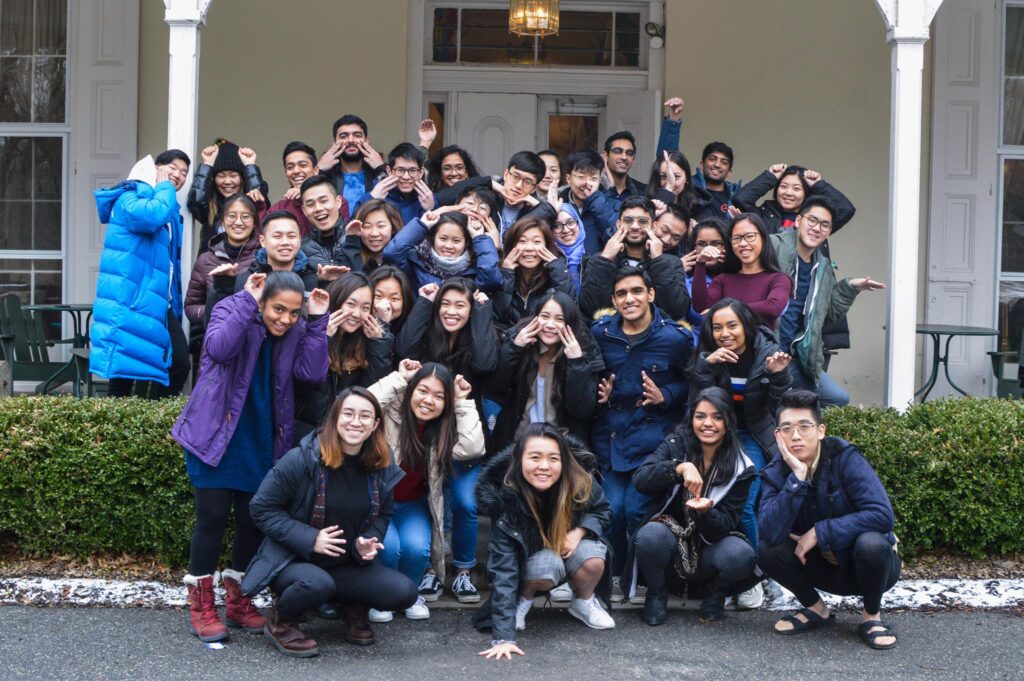
The APALI Retreat sets the foundation for the rest of the program. Participants go off-campus for a weekend retreat and begin to build relationships with each other and develop tangible leadership skills that can be used in the future. They do this as they explore their identities and discuss issues that are pertinent to the Asian Pacific American community.
The Sessions
Following the retreat, members commit to attending 6 sessions throughout the semester. These sessions are usually every other Tuesday from 6:30PM - 9:00PM and are led by two facilitators who have undergone the APALI experience. Topics vary from year to year and evolve with the issues that are facing the APA community. Topics that have been discussed in the past include public speaking, consensus building, model minority, perpetual foreigner, affirmative action, hate crimes and other issues that are relevant to the APA community. By sharing their past experiences, engaging in dialogue, and participating in planned activities, participants learn experientially about their identity, empower themselves, and consequently prepare themselves for leadership roles in the future.
The Resources
In addition to the workshops, APALI subsidizes conference attendance for each student to develop leaderships skills relevant to issues within and beyond the APA community. Some conferences that past APALI graduates have attended include the East Coast Asian American Student Union Conference (ECAASU), the Korean American Students Conference (KASCON), and the Filipino Intercollegiate Networking Dialogue (FIND).
Furthermore, by collaborating with other groups and campus resources, APALI participants are exposed to different aspects of campus life.
Looking Back
"I didn't know what to expect from APALI, but I soon found out. Not only do you learn more about AA issues but you also get a chance to meet others who share your interests. These are the same people that will lead our AA organizations on and off campus in the future. It's a great way to get involved early."
Herman Dulay, APALI Fall 2001
"It was APALI that gave me a sense of membership among and responsibility to my AA peers. The program's intent is far from passive education; in APALI one doesn't just sit around and meditate on your identity, and its activities are a far cry from the 'victim-of-racism' group therapy sessions one finds amongst Asian-American programs nowadays. APALI aims to make all its members pro-active as well as well-informed. It's made me more interested and active in what I now consider my Asian American community."
Sahang-Hee Hahn, APALI Spring 2002
"Although APALI is first a leadership program, it built an understanding of the communities and issues of Asian Pacific America that gave me an awareness of myself necessary to be a productive leader not just in the realm of APA organizations but any facet."
Dana Nakano, APALI Fall 2001
"The great thing about APALI is that every semester, a group of strangers come together every other week to safely and openly discuss really big issues that are so important in the Asian Pacific American community and the entire multi-ethnic community at large. These things are topics that most people rarely get a chance to talk about with anyone. If you get more information and opinions about these issues, then people can finally do things to tackle these problems. APALI allows each class to explore all sides of these problems, and encourages communication amongst the classes and also with the larger community. It lets people stand up for what they feel to be right and really become stronger leaders for their friends and organizations." Ryun Hobbs, W'12
"APALI to me was really the most amazing and rewarding experience I've had at Penn. On a more global scale, it really helped me redefine my identity as an Asian American and opened my eyes to a lot of the issues that Asian Americans face in everyday life. Were it not for my experiences in APALI I would not have been so moved and inspired to get involved in the APA community at Penn and apply/get selected for APAHW board and the PEER mentoring program. On a more personal note, the talks really helped me better understand some of the issues that my family had, particularly my parents, and allowed me to form better relationships with them. I think APALI needs to be continued in order to offer an outlet where people who are interested in APA issues can meet each other and mutually inspire each other to become more pro-active and involved in the Penn community." Scott Lee, C'11
"I suppose I was a little bit arrogant going into APALI. I told myself to expect to learn about Asian American culture, to meet new people, and to learn about leadership. I knew what was going to happen and I had it all figured it out. Well, my expectations were certainly met. I learned that, despite my involvement in the Asian American community at Penn, I really knew next to nothing about Asian American history. I met and made new friends, friends who humble me with their intelligence and passions, and friends who shame me forever thinking poorly of my relatively privileged and peaceful upbringing. I learned that I still had a lot to figure out about myself before I could truly call myself a leader and inspire others. But above all else, I was surprised to learn just how rooted and rigid my way of thinking was. Without revealing the trade secrets of one of the games we played, I found out that my brain and eyes just could not see what others plainly could. I became one of the last in my group to finally figure out a puzzle whose solution is so obvious that it drove me to severe frustration when I finally worked it out. My APALI brothers and sisters (as we affectionately refer to ourselves) will recall that I exhibited a rare moment of anger and, like all good friends are, they were concerned for me and told me it was just a game. Rest assured, I didn't slam any chairs or commit any violence, but I did sulk for a bit. I'm embarrassed to think back on my reaction even today, over 6 months since we played the game. But I think that lesson taught me the most about myself than anything else we did during that wonderful weekend retreat. I didn't expect to reevaluate how I thought about things and figured out problems, but I'm grateful that I did." Tony Liu W'12
"As Asian Americans, APALI introduced us to a dialogue about personal cultural identities and where those identities placed us in society. I'm so grateful that it made me aware of APA achievements, historical roots, and issues of concern that still need to be addressed. For the welcoming inclusion that APALI and PAACH offered, it has honestly been among the greatest experiences I have ever had in my life. It drastically affected my worldview, as well as fueled my motivations to give back to the Asian Pacific American community at Penn. Bringing the state of the APA community into our consciousness also inspires young students, who have so much potential, to factor in the well being of these minority communities into their involvement. The program is an innovative way of learning in itself, as it draws upon a combination of external knowledge, personal history, and shared experiences with the rest of the APALI class. Getting to talk so readily and draw upon my own experiences instead of regurgitating external readings really drives the message home and encourages personal involvement to the subject matter." Jenny Fan '12
"Going through APALI encouraged me to be more involved on campus, and also to talk about what it means to be Asian-American with my parents and my friends outside of the sessions. It also helped me talk about other things, such as my family life, what it's like to deal with a family member with Asperger's Syndrome. APALI was a great place to share, grow and learn. The things I experienced and learned from APALI I now apply to my day-to-day life, in terms of community building and being a more proactive student and leader on campus.Most importantly, this class gave me friends and mentors from all over the community. Our facilitators were people to go to when you needed advice about anything, from school to friends to family. They always welcomed us to voice our opinion and use them and the Pan-Asian American Community House at Penn as resources. APALI has broadened my horizons, and I hope people continue being able to experience at Penn, and take away what I took away from it." Sasha Verma SEAS '12
Getting Involved
To become a part of APALI, you must be nominated (self-nominations are accepted) and submit an application. For more information, email shiella@upenn.edu.
[Back to Programs] | [Back to Top] | [Home]